LOL
this is my favourite for 2day
Фліт - Їжачок
Наша розповідь про їжачка
Про маленького неслухняного
Як спіткала малого біда
Вже не жвавого не рум’яного
В темнім лісі багато пригод
Птахи, равлики, скунси, олені
Та чомусь потягнуло його
На доріженьку асфальтовану
Їжачок! Піднімись , підберись!
Їжачок! Разом з нами посміхнись!
Їжачок! Навкруги озирнись! Їжачок! Їжачок!
Але він перетвориться в зірку
І лапками весь світ обійме
Не чіпайте його не треба
Хай він сили у собі знайде
Міг би бути щасливим кінець
Як би було все по-інакшому
Та біжав він собі навпростець
І раптово тут звідкись машіна
І відбулась кривава біда
Ми про неї вам не розкажемо
Але факт вже малого нема
І сволота зла непокарана
Support Ukrainian!
mad0Їжачок
P.S. http://www.flit.net.ua/
Showing posts with label Ukraine. Show all posts
Showing posts with label Ukraine. Show all posts
Friday, September 19, 2008


Wednesday, September 17, 2008
Monday, September 15, 2008
Kiev City
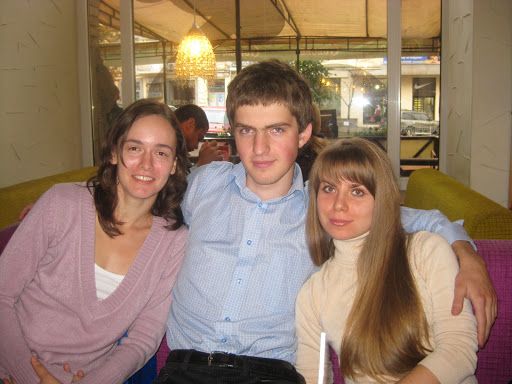
Hoi zäme,
вот я и дома :-)
Писать что Украина и Швуйцария - разные страны смысла не имеет (хотя все же я бложжу об этом). Дома хорошо! Дома тебя всегда ждут родные и близкие. Дома ты чувствуешь себя как рыба в воде. Ты здесь свой (это мой город, это мой район).
Конечно, к некоторым вещам привык, но обратный процесс -- дело пару дней, я полагаю. С другой стороны - это опыт жизни в другой стране, в другом контингенте. Я видел немного их жизнь. Она не такая белая и кристальная, как многие думают. Не могу сказать, что нас там ждут. Отнюдь.
Но жизнь там более спокойная. Я где-то читал, что по суете и темпу жизни Киев начинает напоминать Лондон. Жаль. Надо наслаждаться каждым мгновением!
Эх, жизнь прекрасна где бы ты, я, мы не были! И любимый человек рядом с тобой... Ммм, я рад, что я дома!
Все, полетел в универ,
Мастер
Thursday, September 11, 2008

Thursday, August 21, 2008
WWW III?
Сегодня с утра прочитал в "20 минутах" о вчерашних действиях Пшешков и Ниггеров.
Это капец. Если наши ж**олизы тоже захотят иметь у себя прикрытие в виде америкосских войск ПВО? А именно туда оно и движеться. Чтобы эти топтали нашу землю? Да низа что!
Поддерживаюю Россию на все 150%! Ведь только слепому не видно, чего они (буш и ко) хотят. Почему Украина никак не отреагировала на это? Или все заняты конфликтом на Кавказе?
Хотя при том, что сейчас у нас передел и гонка за "добычей" (леня космос к примеру дома) немудрено, что наши поддержат америкосов. имхо это конец Украине как нации и ментальности. хотите "хлiба та видовищ"? Вот, пожалуйте.
Наверное, парад на 9 мая показал, что Россия имеет армию и может ее показать. Здешние никогда таких парадов не видели. Очень надеюсь, что наш парад не будет "презентацией подарка" штатам.
Вообщем, "уйди, старушка, я в печали" пока еще катит. Но скоро может быть поздно.
Надо меняться.
Thursday, November 29, 2007
Can't Stand D.C. Traffic? You Should See Kiev.

Well, I Love our city, but have to publish this article, because this really makes sense!
Source: Washington Post
There's a certain fascination in watching a city destroy itself more or less overnight. Kiev last imposed itself on the West's consciousness when it exploded into mass protests during Ukraine's so-called Orange Revolution in 2004. But looking around this still beautiful capital on Europe's edge today, you wonder how much strain an urban fabric can take before it rips.
Kiev's problem is cars. The city's increasingly well-off post-Soviet population has taken to automobiles with the intensity of the long-deprived. Ukraine's booming economy is blast-forging the country's first mass middle class, and by many locals'
count, perhaps 10 times more vehicles are now rumbling through this ancient city's hilly streets than there were when the Soviet Union expired in 1991. In 2006, according to the Kiev Post, Ukraine climbed from 12th place to ninth place in Europe in terms of new car sales, which a leading Ukrainian newsmagazine reports grew 52 percent here from last September to this. About 60,000 new cars were registered in Kiev this October alone, according to the Unian news agency, bloating a total that Ukraine's Emergency Ministry puts at 1.5 million -- and the number is expected to grow by a million more by 2011.
This has meant something catastrophic for life in Kiev. Streets that in 1991 were almost empty and that five years ago remained passable thoroughfares are now gridlocked for most of each business day. In Kiev, cars are what water must be to Venetians or snow to Eskimos: the fundamental shaper of daily experience. Given Ukraine's distinctly Soviet approach to emissions controls, Kiev's air reeks in a way that residents of even the filthiest downtowns of Western capitals can't imagine. You don't want to open your windows by day if you live downtown; better to wait until well into the evening, after the dissipation of the apocalyptic traffic
jams that have become the city's conversation pieces in much the same way that politics were during the Orange Revolution.
All of this is a function of what one Kiev magazine earlier this year dubbed the "Cult of the Automobile" -- the status, unimaginable to Westerners, that comes with car ownership in a society conditioned by Soviet-era scarcity. It was the great Western-looking dream of the Soviet citizen to own a set of wheels, and those dreams are now coming true -- with the help of easy credit, which is everywhere in a country
where speculation was a crime just 20 years ago. Many of the late-model KIAs and Skodas in Kiev are wholly owned by local banks, which is only one of the peculiarities of a car culture so seductive that I've heard anecdotes about people who have sold elegant apartments to get cash to buy cars. Another peculiarity: Cars are really unnecessary here because Kiev's Soviet-built subway system is excellent.
And all of this is a shame, given that Kiev has historically been considered the most pleasant of the former Soviet Union's capitals -- a walkable alternative to Moscow. In his book "Imperium," about his travels through the declining Soviet Union, the late Polish journalist Ryszard Kapuscinski described Kiev as "the only large city of the former USSR whose streets serve not merely for hurrying home but for walking, for strolling." Kiev's main boulevard, Khreschatyk, he wrote, is something like a local Champs-Elys¿es, and he was impressed by Kiev's downtown "crowds of people" out "to get some fresh air."
A decade and a half later, the city that Kapuscinski liked no longer exists. Walking here can be dangerous because the sidewalks are covered with cars, both parked and moving. That ritual of city life -- the promenade -- has become an adventure in the sort of defensive, serpentine ambulation with which the pedestrian makes his way through a strip mall parking lot. And it doesn't help that Ukrainian traffic cops know better than to stop expensive vehicles: It can be bad for their careers. Drive a Hummer or a Bentley here (Bentleys are common), and you can barrel through any red
light and over any lawn or sidewalk.
The situation is exacerbated by Kiev's geography. The city is composed of a compact downtown core that would seem better in a smaller city -- Oakland, say, not a growing population cluster of perhaps 5 million. An increasing number of Kiev's residents live in bedroom communities outside the city, endless developments of high-rise towers that each month radiate farther across the plains. Because these futuristic tower blocks don't include office space, the city's circumscribed downtown is overloaded. It's as though all of New York's economic activity were restricted to an area the size of Greenwich Village and SoHo combined.
Kiev's preponderance of wide boulevards and vast plazas -- communist showcases for an era before the automobile reigned -- exacerbate the situation, too. What 10 years ago were pleasant poplar-lined boulevards are now clogged eight-lane highways that scream and honk and pound through the city's heart. Looking at central Kiev's Victory
Square is like looking down at a gridlocked Los Angeles freeway, except that many of the cars are going in opposite directions, there's more toxic haze and tens of thousands of people have to live within yards of it.
Where all this will end up, it's hard to tell. Kiev's transformation -- from a charmingly shabby stroller's city of dusty squares and streets in which there might be more stray dogs than SUVs into an increasingly charmless automotive dystopia -- has happened mostly during the past five years of economic growth.
Like survivors of a flash flood, residents (especially those who don't own cars) are
just coming to terms with the sudden change in their physical reality. Their neighbors in Europe have started dealing with the antisocial effects of urban car use and are banning, restricting or taxing driving in many downtown cores. But Ukraine, despite the aspirational rhetoric of some of its Western-looking politicians, isn't Europe. In a macho culture that has embraced conspicuous consumption, the idea of people taking to bicycles like the burghers of Amsterdam is inconceivable. Just a little less so is the idea that, in a nondemocratic culture defined by elite prerogative, the newly affluent will use public transportation like wealthy Westerners. And a culture with an almost totally corrupt public life, no functioning justice system and a tendency toward political murder seems unlikely to make "green" choices when it comes to urban planning.
Barring some unexpected development, Kiev seems fated to become less and less the "European" city that the westward-looking Orange Revolution declared it to be and more and more a hub of Third World-style chaos. Certainly the pollution situation is disturbing. Ukraine was an ecological basket case even before the car culture, and unlike car-mad America or similarly polluted Russia, it doesn't have excess space to destroy.
There is a geopolitical irony to all this: Ukraine, a poor and weak country with no oil of its own, is giving itself over to a car- and oil-based culture at a moment when that culture is approaching its limits. The global cheap-oil party is approaching its end even as Ukraine shoves its way into the rubbish-strewn foyer
near midnight.
And while Ukraine may be spared $100 barrels of oil on the world market, that's only because it has a potentially bigger problem: It gets all its oil from or through Russia, an assertive power whose leadership resents seeing its old vassal persist in its delusions of independence. Russia has also proved willing to use the "energy weapon" against Ukraine, as seen in the 2006 European gas crisis, when Russia briefly shut off gas supplies to its southerly "little brother." And so every time a patriotic Ukrainian proudly fills up his new Prado, he's pushing his vulnerable country further into the arms of the hegemon to the north. It's yet another bleak historical irony for Ukraine that its giddy embrace of Western automotive culture may someday seal its ultimate submission to Russia -- and sever it from the West.
Kiev's problem is cars. The city's increasingly well-off post-Soviet population has taken to automobiles with the intensity of the long-deprived. Ukraine's booming economy is blast-forging the country's first mass middle class, and by many locals'
count, perhaps 10 times more vehicles are now rumbling through this ancient city's hilly streets than there were when the Soviet Union expired in 1991. In 2006, according to the Kiev Post, Ukraine climbed from 12th place to ninth place in Europe in terms of new car sales, which a leading Ukrainian newsmagazine reports grew 52 percent here from last September to this. About 60,000 new cars were registered in Kiev this October alone, according to the Unian news agency, bloating a total that Ukraine's Emergency Ministry puts at 1.5 million -- and the number is expected to grow by a million more by 2011.
This has meant something catastrophic for life in Kiev. Streets that in 1991 were almost empty and that five years ago remained passable thoroughfares are now gridlocked for most of each business day. In Kiev, cars are what water must be to Venetians or snow to Eskimos: the fundamental shaper of daily experience. Given Ukraine's distinctly Soviet approach to emissions controls, Kiev's air reeks in a way that residents of even the filthiest downtowns of Western capitals can't imagine. You don't want to open your windows by day if you live downtown; better to wait until well into the evening, after the dissipation of the apocalyptic traffic
jams that have become the city's conversation pieces in much the same way that politics were during the Orange Revolution.
All of this is a function of what one Kiev magazine earlier this year dubbed the "Cult of the Automobile" -- the status, unimaginable to Westerners, that comes with car ownership in a society conditioned by Soviet-era scarcity. It was the great Western-looking dream of the Soviet citizen to own a set of wheels, and those dreams are now coming true -- with the help of easy credit, which is everywhere in a country
where speculation was a crime just 20 years ago. Many of the late-model KIAs and Skodas in Kiev are wholly owned by local banks, which is only one of the peculiarities of a car culture so seductive that I've heard anecdotes about people who have sold elegant apartments to get cash to buy cars. Another peculiarity: Cars are really unnecessary here because Kiev's Soviet-built subway system is excellent.
And all of this is a shame, given that Kiev has historically been considered the most pleasant of the former Soviet Union's capitals -- a walkable alternative to Moscow. In his book "Imperium," about his travels through the declining Soviet Union, the late Polish journalist Ryszard Kapuscinski described Kiev as "the only large city of the former USSR whose streets serve not merely for hurrying home but for walking, for strolling." Kiev's main boulevard, Khreschatyk, he wrote, is something like a local Champs-Elys¿es, and he was impressed by Kiev's downtown "crowds of people" out "to get some fresh air."
A decade and a half later, the city that Kapuscinski liked no longer exists. Walking here can be dangerous because the sidewalks are covered with cars, both parked and moving. That ritual of city life -- the promenade -- has become an adventure in the sort of defensive, serpentine ambulation with which the pedestrian makes his way through a strip mall parking lot. And it doesn't help that Ukrainian traffic cops know better than to stop expensive vehicles: It can be bad for their careers. Drive a Hummer or a Bentley here (Bentleys are common), and you can barrel through any red
light and over any lawn or sidewalk.
The situation is exacerbated by Kiev's geography. The city is composed of a compact downtown core that would seem better in a smaller city -- Oakland, say, not a growing population cluster of perhaps 5 million. An increasing number of Kiev's residents live in bedroom communities outside the city, endless developments of high-rise towers that each month radiate farther across the plains. Because these futuristic tower blocks don't include office space, the city's circumscribed downtown is overloaded. It's as though all of New York's economic activity were restricted to an area the size of Greenwich Village and SoHo combined.
Kiev's preponderance of wide boulevards and vast plazas -- communist showcases for an era before the automobile reigned -- exacerbate the situation, too. What 10 years ago were pleasant poplar-lined boulevards are now clogged eight-lane highways that scream and honk and pound through the city's heart. Looking at central Kiev's Victory
Square is like looking down at a gridlocked Los Angeles freeway, except that many of the cars are going in opposite directions, there's more toxic haze and tens of thousands of people have to live within yards of it.
Where all this will end up, it's hard to tell. Kiev's transformation -- from a charmingly shabby stroller's city of dusty squares and streets in which there might be more stray dogs than SUVs into an increasingly charmless automotive dystopia -- has happened mostly during the past five years of economic growth.
Like survivors of a flash flood, residents (especially those who don't own cars) are
just coming to terms with the sudden change in their physical reality. Their neighbors in Europe have started dealing with the antisocial effects of urban car use and are banning, restricting or taxing driving in many downtown cores. But Ukraine, despite the aspirational rhetoric of some of its Western-looking politicians, isn't Europe. In a macho culture that has embraced conspicuous consumption, the idea of people taking to bicycles like the burghers of Amsterdam is inconceivable. Just a little less so is the idea that, in a nondemocratic culture defined by elite prerogative, the newly affluent will use public transportation like wealthy Westerners. And a culture with an almost totally corrupt public life, no functioning justice system and a tendency toward political murder seems unlikely to make "green" choices when it comes to urban planning.
Barring some unexpected development, Kiev seems fated to become less and less the "European" city that the westward-looking Orange Revolution declared it to be and more and more a hub of Third World-style chaos. Certainly the pollution situation is disturbing. Ukraine was an ecological basket case even before the car culture, and unlike car-mad America or similarly polluted Russia, it doesn't have excess space to destroy.
There is a geopolitical irony to all this: Ukraine, a poor and weak country with no oil of its own, is giving itself over to a car- and oil-based culture at a moment when that culture is approaching its limits. The global cheap-oil party is approaching its end even as Ukraine shoves its way into the rubbish-strewn foyer
near midnight.
And while Ukraine may be spared $100 barrels of oil on the world market, that's only because it has a potentially bigger problem: It gets all its oil from or through Russia, an assertive power whose leadership resents seeing its old vassal persist in its delusions of independence. Russia has also proved willing to use the "energy weapon" against Ukraine, as seen in the 2006 European gas crisis, when Russia briefly shut off gas supplies to its southerly "little brother." And so every time a patriotic Ukrainian proudly fills up his new Prado, he's pushing his vulnerable country further into the arms of the hegemon to the north. It's yet another bleak historical irony for Ukraine that its giddy embrace of Western automotive culture may someday seal its ultimate submission to Russia -- and sever it from the West.
Tuesday, November 27, 2007
Ukraine University Education

Just a few thoughts about Education in our country. I don't think it really gives knowledge! It just teaches humans how to get out of the diffucult situations (on exams 4 example, nothing more).
Do you think it looks good, when we attend lessons, where teacher reads the course from his/her papers? It's a reading practice, not a teaching process..
I should have realized all this stuff before!
Very Upset!
Any comments?
Subscribe to:
Posts (Atom)
![[Untitled-1.jpg]](https://blogger.googleusercontent.com/img/b/R29vZ2xl/AVvXsEigq_NXQcKH5F9E48LdUkUt40oONI6ZZQ3rESLd6-JsrYr5ZdZVS3HkATcovfa-U9z6wG4GdiBwW4eKvVmiChDFagGmEMQGC0WXKIouJLVcBzKGzFuwrWdMp6w0NN1EuHn25ubTyGcbeZoa/s1600/Untitled-1.jpg)